
Quick Birth Chart Breakdown Guide
A fast, repeatable method for reading any chart. Start simple, then layer in details without getting overwhelmed.
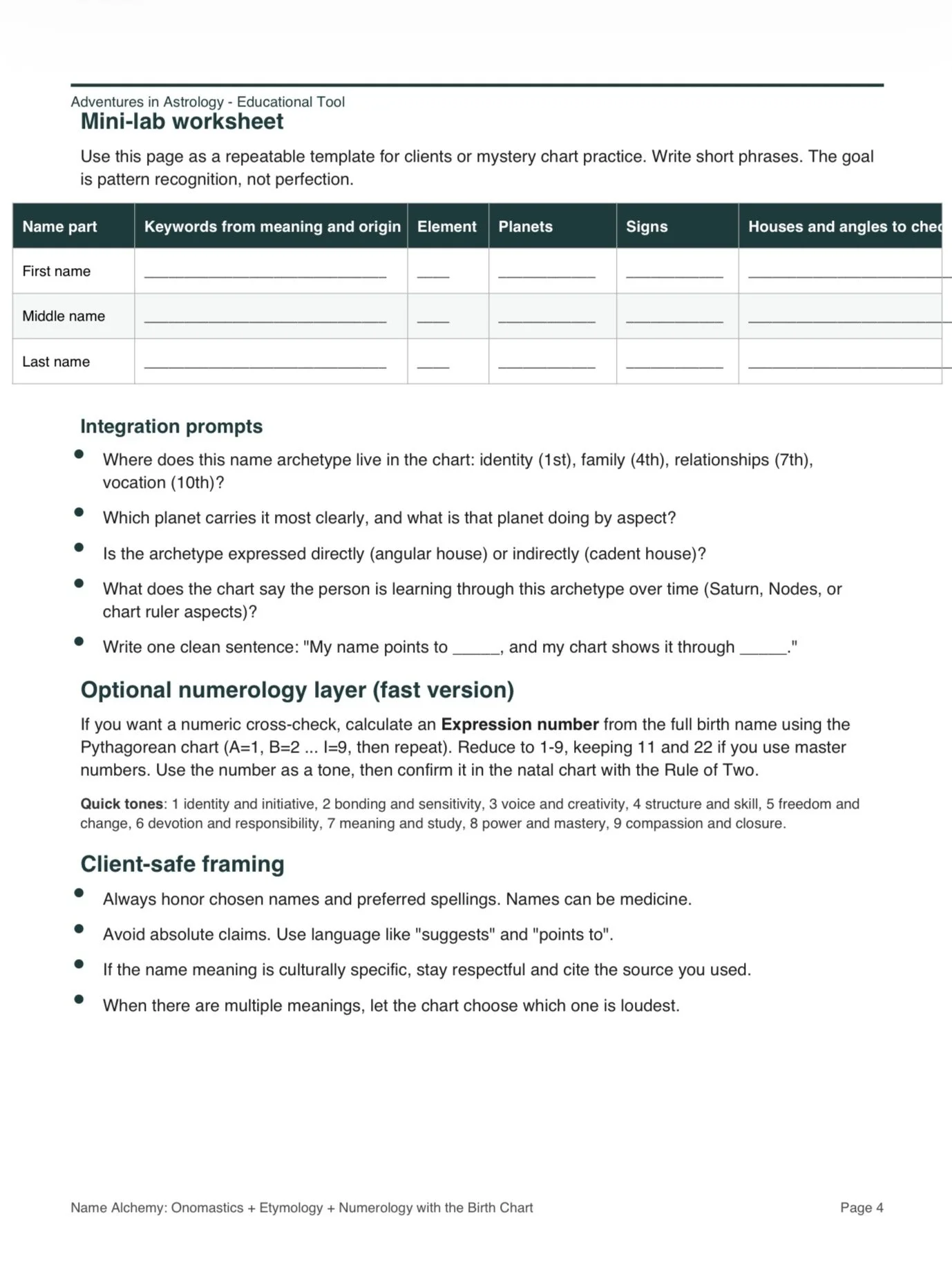
The Quick-Read Flow (use this every time)
If you only do these steps, you will still give a solid reading. Everything else is optional layering.
1) Big 3 and angles
- Rising sign sets the approach, vibe, and life lens
- Sun shows identity development and purpose focus
- Moon shows emotional needs and instinct patterns
- MC shows public direction, reputation, and calling themes
2) Chart ruler and core story
- Find the ruler of the Ascendant sign
- Read its sign, house, and major aspects
- This often describes the main character path
3) Personal planets next
- Mercury: mind and communication patterns
- Venus: values, relating, attraction, and harmony
- Mars: drive, desire, conflict style, and action
- Look for tight aspects and house emphasis
4) Social and outer planets
- Jupiter and Saturn show growth and structure lessons
- Uranus, Neptune, Pluto personalize through aspects and angles
- Notice conjunctions to Sun, Moon, Asc, MC first
5) Synthesis sentence
- Write one sentence that combines chart ruler + Sun + Moon
- Add 1 house emphasis and 1 major aspect
- That is your quick read foundation
6) Add timing if needed
- Transits: what is being pressed right now
- Profections: what house is loud this year
- Progressions: slow emotional development signals
The Layering Formula (how to build meaning)
Planet = what function is operating
Sign   = how that function behaves
House  = where it shows up in life
Aspects = what it connects with and how it blends or conflicts
Condition = strength (dignity, speed, retrograde, angularity)
Timing = when the story is activated
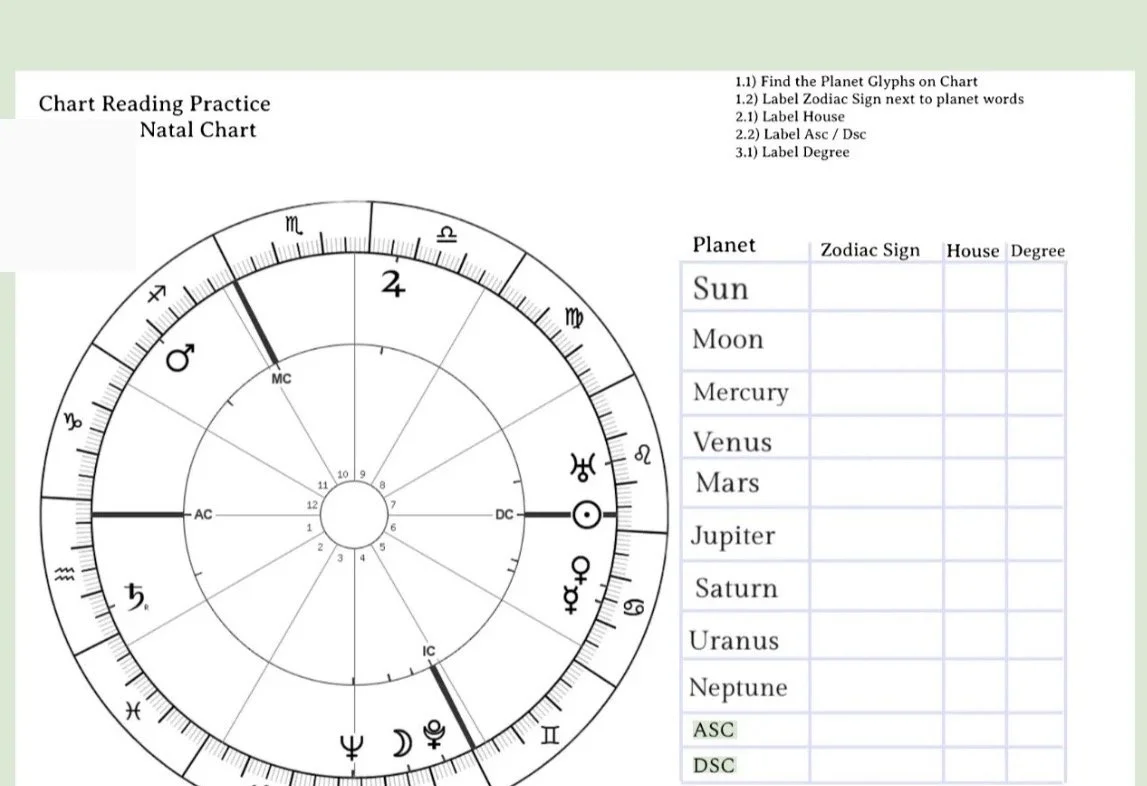
Planets and Their Core Themes
| Planet | Core theme (what it represents) | Quick read prompts |
|---|---|---|
| Sun | Identity, vitality, purpose, leadership style | Where do they shine? What motivates pride and growth? |
| Moon | Emotional needs, safety instincts, habits, attachment patterns | What calms them? What triggers protective behavior? |
| Mercury | Thinking, learning, communication, perception, language | How do they process information and express ideas? |
| Venus | Values, relationships, pleasure, aesthetics, social magnetism | What do they prioritize? How do they connect and repair? |
| Mars | Drive, desire, courage, anger style, pursuit, boundaries | How do they go after goals? How do they handle conflict? |
| Jupiter | Growth, meaning, faith, opportunity, teaching, expansion | Where do doors open? What beliefs guide their choices? |
| Saturn | Structure, responsibility, mastery, limits, time, commitment | Where is the life lesson? What requires patience and practice? |
| Uranus | Change, liberation, surprise, rebellion, innovation | Where do they need freedom? What disrupts to evolve them? |
| Neptune | Imagination, spirituality, longing, idealization, fog and sensitivity | Where do they dream? Where can they blur lines or escape? |
| Pluto | Power, depth, transformation, obsession, renewal, shadow work | Where do they go intense? What must be released and rebuilt? |
| North Node | Growth direction, future skill building, unfamiliar development path | What qualities are they learning to embody over time? |
| South Node | Comfort zone, past patterns, instinct defaults, old mastery | What is easy but can become repetitive or limiting? |
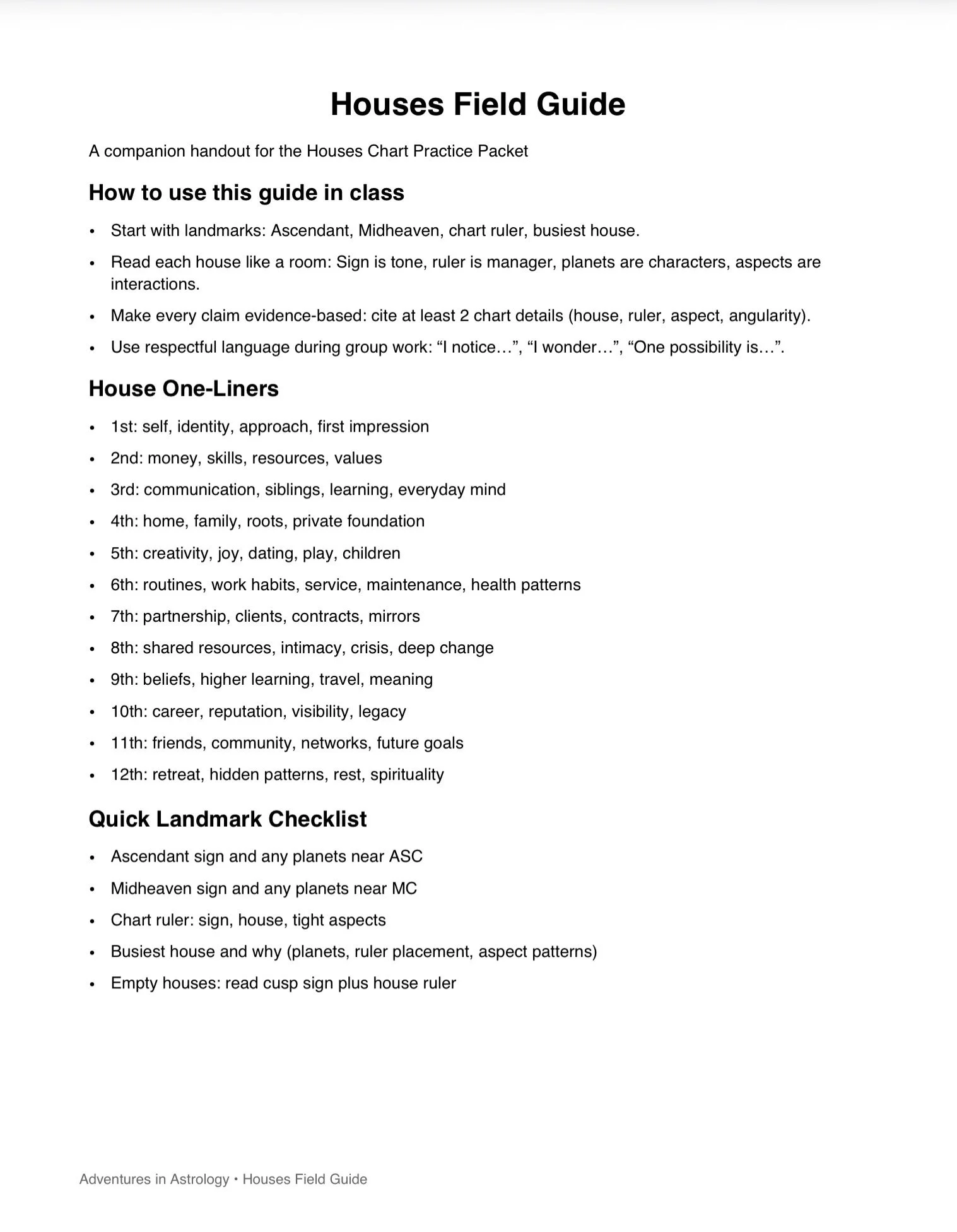
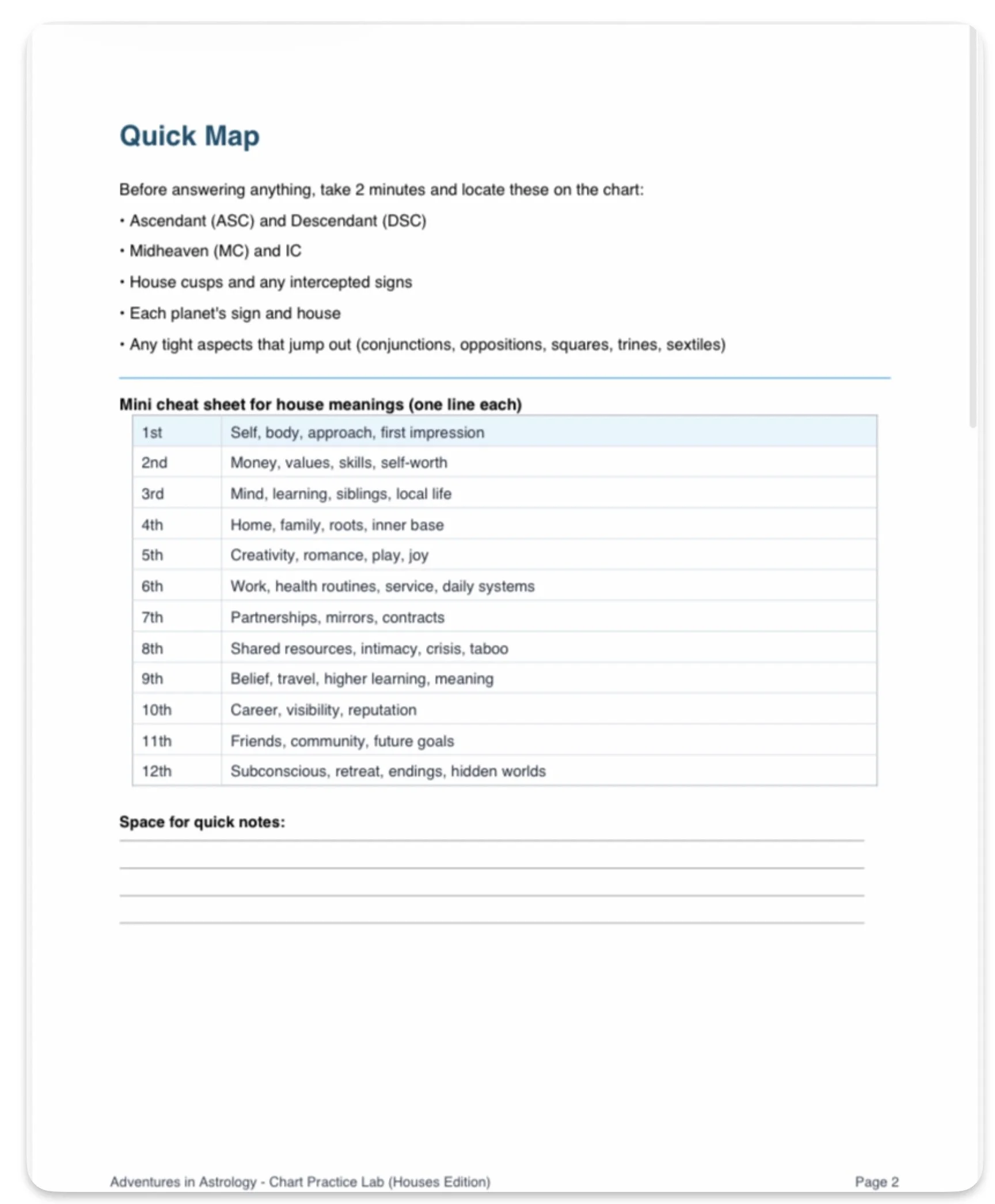
Houses and Their Life Themes
| House | Main life area | Quick read prompts |
|---|---|---|
| 1st | Self, body, approach, first impressions, identity style | How do they enter a room? What is their baseline energy? |
| 2nd | Money, resources, self worth, skills, stability | What do they value? How do they build security? |
| 3rd | Learning, communication, siblings, neighborhood, daily mind | How do they think and speak? What topics fascinate them? |
| 4th | Home, roots, family patterns, inner life, private self | What shaped them? What do they need at home to feel safe? |
| 5th | Creativity, romance, play, joy, performance, children | What makes life feel fun and alive? How do they express love? |
| 6th | Work habits, health routines, service, systems, daily upkeep | How do they manage life logistics? What supports wellbeing? |
| 7th | Partnerships, commitment, contracts, mirrors, collaboration | What do they seek in others? What patterns repeat in relationships? |
| 8th | Shared resources, intimacy, trust, endings, transformation | Where do they merge deeply? What triggers growth through intensity? |
| 9th | Beliefs, higher learning, travel, meaning, worldview | What expands them? What philosophies guide them? |
| 10th | Career, reputation, public role, authority, long term aims | How are they seen? What are they building over time? |
| 11th | Community, friends, networks, causes, future goals | Where do they belong? What collective vision do they support? |
| 12th | Subconscious, solitude, healing, hidden patterns, spiritual processing | What needs quiet time? What operates behind the scenes? |
How to Add On From There (without getting lost)
Layer 1: Sign nuance (the style)
- Element: fire, earth, air, water
- Modality: cardinal, fixed, mutable
- Ruler: the sign ruler becomes a supporting character
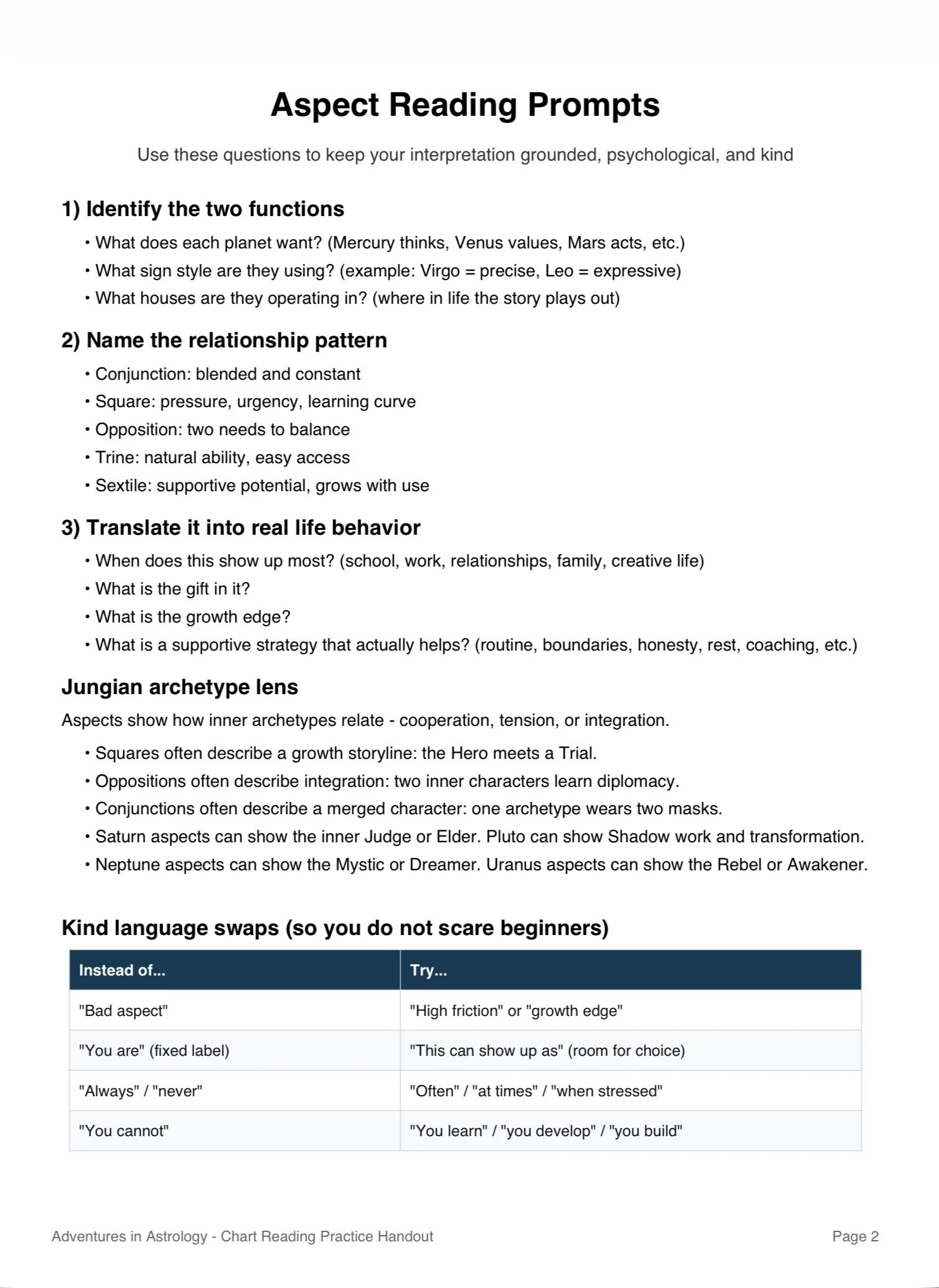
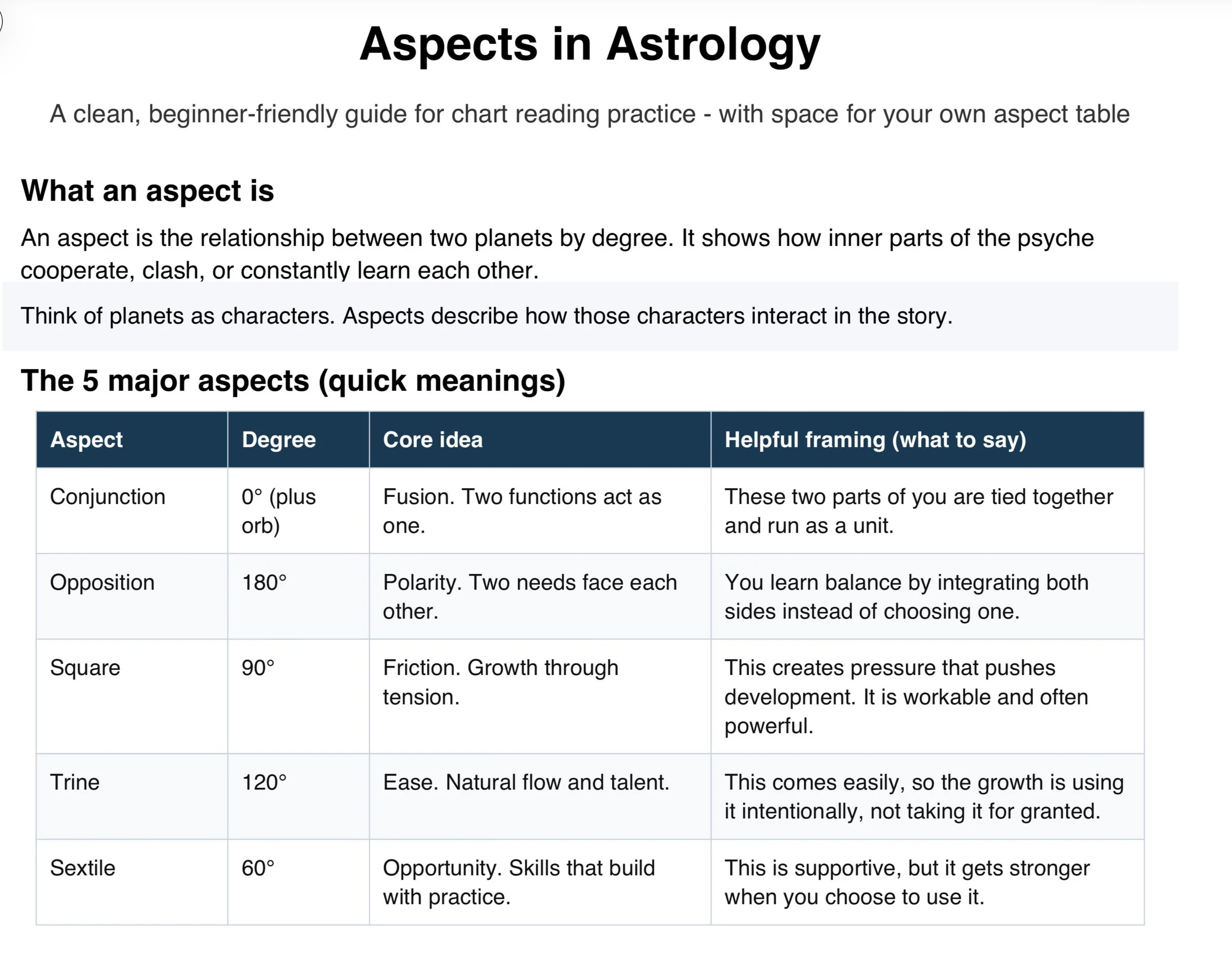
Layer 2: Aspects (the conversation between parts)
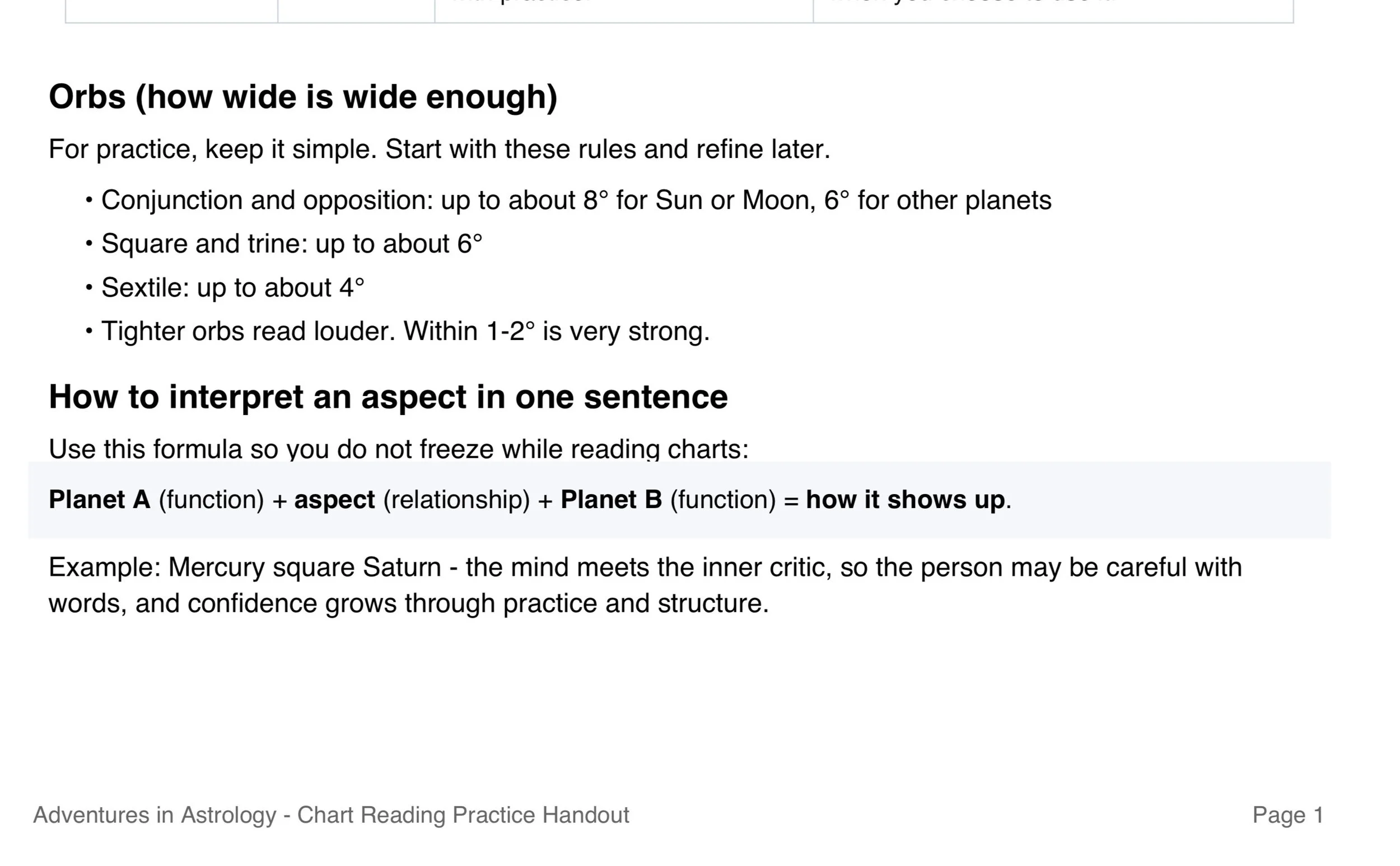
- Conjunction: fused, intensified
- Opposition: polarized, mirrored through others
- Square: friction that develops skill
- Trine: ease and talent
- Sextile: opportunity through effort
Layer 3: House emphasis (what is loud)
- Stelliums or multiple placements in one house
- Planets on angles (1st, 4th, 7th, 10th)
- Empty houses still matter through their rulers
Layer 4: Dispositors and rulership chains
- Example: Venus in Aries is ruled by Mars, so Mars becomes a key voice
- Final dispositor or mutual reception can strongly color the chart
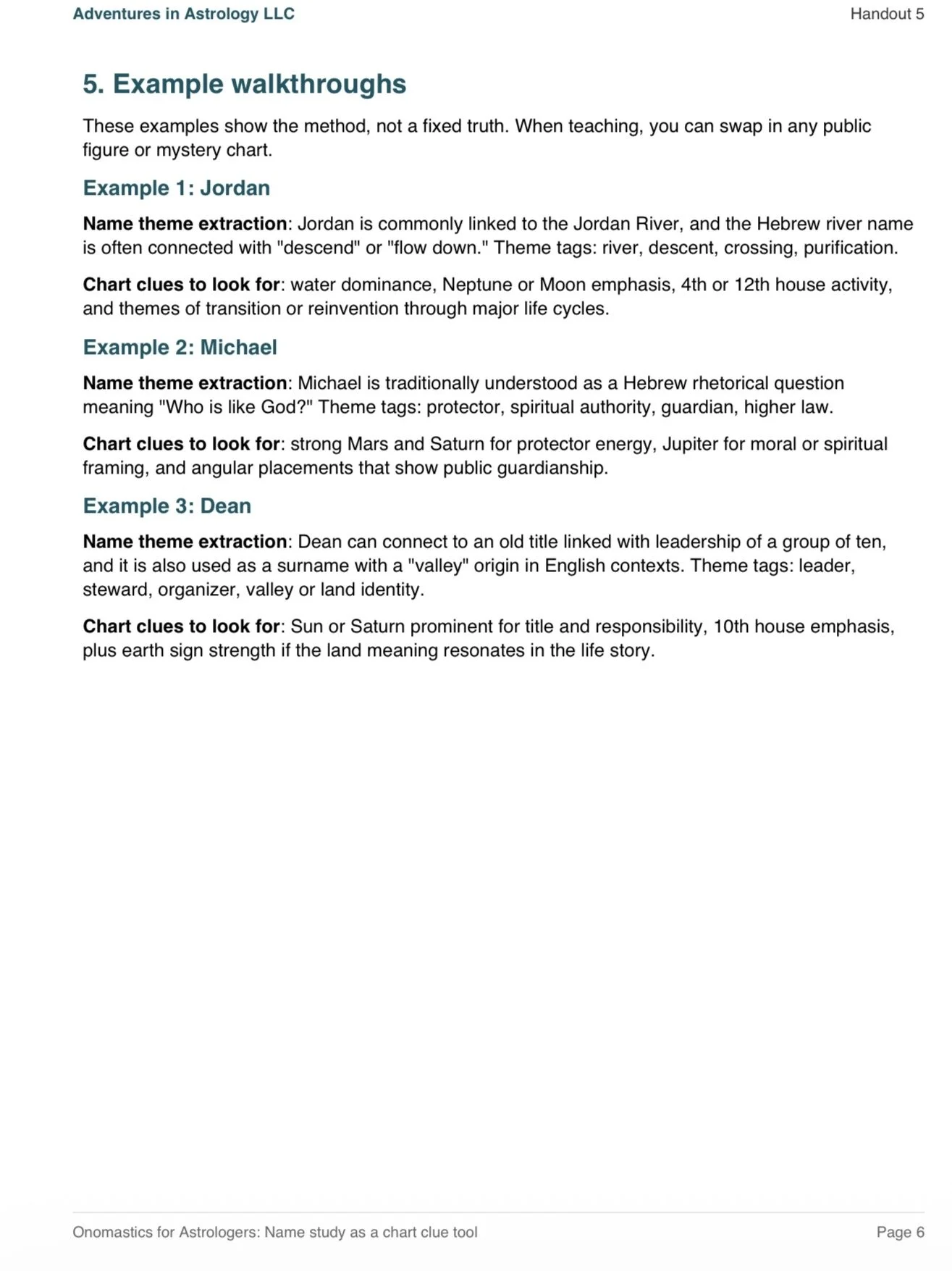
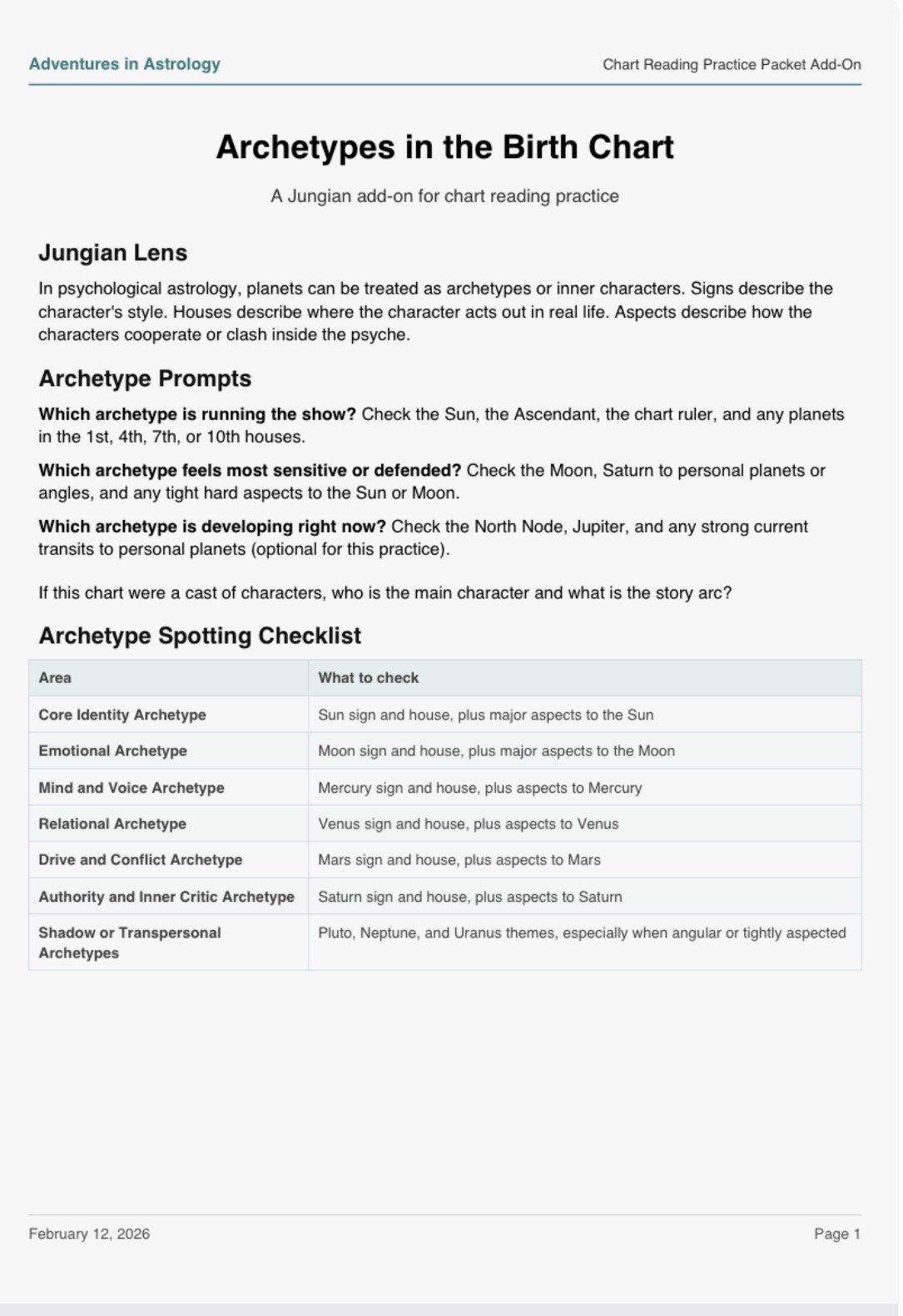
Jungian Astropsychology Archetype Finder
A practical method for identifying dominant archetypes in a natal chart and interpreting the psyche through symbols, patterns, and developmental themes.
The Method (fast, repeatable, and chart-friendly)
1) Spot what is loud
- Angular planets (1st, 4th, 7th, 10th)
- Stelliums or house/sign emphasis
- Tight aspects to Sun, Moon, Asc, or MC
- Chart ruler placement and aspects
2) Name the psychic functions
- Sun = ego and identity center
- Moon = instinct and attachment needs
- Mercury = mind and meaning-making
- Venus = relating and value system
- Mars = will, boundaries, desire
3) Translate into archetypes
- Use the strongest planet(s) first
- Add sign mythic tone and house storyline
- Use aspects as “inner dialogue” themes
- Pick 2–4 core archetypes, not 12
4) Interpret developmentally
- What is the gift (healthy expression)?
- What is the shadow (overuse, defense, distortion)?
- What is the growth task (integration)?
- Where does it play out (house + ruler chain)?
Four Jungian Lenses You Can Map to the Chart
Persona (the social mask)
- How do they present and perform competence?
- What traits do they lead with automatically?
- What roles do they get “cast” into publicly?
Shadow (repressed or disowned material)
- What traits feel risky to embody openly?
- What triggers strong reactions or control patterns?
- Where do they repeat a cycle until it’s understood?
Anima/Animus (inner relational imago)
- What qualities do they idealize or pursue?
- What kind of partner dynamic mirrors their inner life?
- Where do attraction patterns teach integration?
Self (integration and individuation)
- What is the lifelong integration theme?
- What gets stronger with age and commitment?
- Where does meaning deepen after initiations?
Planetary Archetype Map (healthy, shadow, integration)
| Planet | Archetype keywords | Shadow expressions | Integration questions |
|---|---|---|---|
| Sun | Hero, Sovereign, Creator, Leader | Inflation, pride, fragile ego, identity rigidity | Where do I lead with integrity instead of performance? |
| Moon | Caregiver, Child, Protector, Receiver | Emotional control, overattachment, hypersensitivity, reactivity | What do I need to feel safe without shrinking my life? |
| Mercury | Trickster, Messenger, Student, Analyst | Overthinking, rationalization, detachment, nervous looping | How can my mind serve truth instead of defense? |
| Venus | Lover, Diplomat, Artist, Harmonizer | People pleasing, avoidance, validation seeking, possessiveness | What do I value enough to choose it consistently? |
| Mars | Warrior, Athlete, Protector, Initiator | Anger spikes, domination, impulsivity, burnout, conflict avoidance | Where do I need clean boundaries and direct action? |
| Jupiter | Sage, Explorer, Teacher, Mentor | Excess, preaching, inflated certainty, escapism through “meaning” | What belief expands me without disconnecting from reality? |
| Saturn | Elder, Builder, Judge, Realist | Fear, shame, harsh inner critic, rigidity, procrastination | What responsibility creates freedom when I commit to it? |
| Uranus | Rebel, Liberator, Genius, Awakener | Chaos, detachment, contrarianism, instability for its own sake | Where can I innovate in a way that is sustainable? |
| Neptune | Mystic, Dreamer, Poet, Healer | Fog, denial, idealization, boundary collapse, escapism | What is the difference between intuition and avoidance here? |
| Pluto | Alchemist, Phoenix, Shaman, Strategist | Control, obsession, manipulation, paranoia, power struggles | What must die so something truer can be born? |
Aspects as Inner Dialogue (Jung-friendly)
Conjunction: fused archetypes
- Gift: intensity, focus, talent
- Shadow: one function hijacks the other
- Look for: identity themes, “this is who I am” statements
Opposition: projection and polarity
- Gift: awareness through reflection
- Shadow: projection, ping-pong dynamics
- Integration: hold both truths without splitting
Square: friction that builds skill
- Gift: grit, capability, mastery over time
- Shadow: stuck loops, defensiveness, self-sabotage
- Integration: practice, honesty, consistent choices
Trine and sextile: ease and opportunity
- Gift: natural strengths, creativity, confidence
- Shadow: coasting, avoidance of challenge
- Integration: use the gift intentionally
Quick aspect prompt:
What are the two archetypes involved
How does the sign style change each one
Where do they act out in life (houses)
What does “integration” look like in real behavior
House Emphasis = The Stage Where the Archetype Acts
Fast cues
- 1st and 10th: persona becomes very visible
- 4th and 12th: inner life themes, ancestry, unconscious patterns
- 7th and 8th: projection, intimacy, power and trust themes
- 2nd and 6th: embodiment, routines, self worth, skill building
Use rulers to deepen
- Find the sign on the house cusp
- Follow its ruler to the ruler’s house
- This shows where the storyline “goes next”
- Great for empty houses
Synthesis Template (copy and reuse)
Core persona: Ascendant + chart ruler = ______________________
Identity archetype: Sun sign/house + aspects = ______________________
Emotional archetype: Moon sign/house + aspects = ______________________
Dominant supporting archetype(s): Venus/Mars/Mercury emphasis = ______________________
Shadow doorway: Saturn/Pluto hard aspects or 8th/12th themes = ______________________
Integration path: one behavior change or practice that embodies the “Self” = ______________________
Client-friendly questions (Jungian tone, practical wording)
- When you feel stressed, what part of you takes over automatically?
- What traits do you admire in others but hesitate to claim for yourself?
- Where do you repeat a pattern even when you know better?
- What would “mature expression” of this planet look like in real life?
- What daily habit would support integration for the next 30 days?
Chart Practice Question Guide
Use these prompts to ask me questions during our group chart study. The goal is to connect the symbols in the chart to real-life experiences.
How to Use This Guide
Pick one area below, ask 1–3 questions, and let the answers lead you back to the chart. If you notice a placement and want to test it, ask for a real-life example that matches the symbolism.
Childhood and family imprint
- What was the emotional vibe of your home when you were growing up?
- Who felt like the main authority figure and what were they like?
- What role did you naturally fall into in your family?
- What did you learn early about safety, conflict, or support?
- Were there any big moves, changes, separations, or major family transitions?
- What was your relationship like with your mom figure and dad figure?
Early learning and communication style
- What type of student were you and what helped you learn best?
- Did you talk a lot as a kid, stay quiet, or switch depending on the setting?
- What subjects were easy for you and what felt frustrating?
- Were you more observational, outspoken, playful, serious, or sensitive in school?
- Did you feel misunderstood or labeled in any way early on?
- How did you handle teachers, rules, and structure in learning spaces?
Identity, confidence, and self-expression
- When did you first feel like you really knew who you were?
- What kind of environments bring out your confidence the most?
- What parts of you have you had to “own” over time?
- What do people notice about you right away?
- What do you wish people understood better about you?
- When do you feel most like yourself?
Relationships and social patterns
- What types of people do you naturally attract into your life?
- What relationship patterns have repeated over time?
- How do you handle conflict with others?
- Do you prefer closeness, independence, or a mix?
- What do you need to feel emotionally safe in a partnership?
- How do friendships differ from romantic relationships for you?
Challenges, pressure, and growth arcs
- What has been one of your biggest repeating life challenges?
- What responsibilities did you have early that shaped you?
- When have you felt tested, delayed, or forced to mature quickly?
- What fears have you had to work through to level up?
- What life lesson took time but ended up making you stronger?
- What topic do you take very seriously, even if others don’t see it?
Career, purpose, and direction
- What kinds of work have felt meaningful to you and why?
- How do you want to be seen or remembered?
- What “calling” themes have followed you throughout your life?
- Do you prefer autonomy, leadership, teamwork, or behind-the-scenes roles?
- What motivates you more, security or freedom?
- What work environment drains you and what environment energizes you?
Health, routines, and daily life
- What routines keep you stable and what routines are hardest to maintain?
- How do you handle stress in your body and day-to-day habits?
- Do you function better with structure or flexibility?
- What kind of work pace feels sustainable to you?
- What do you do when you start to feel overwhelmed?
- What lifestyle changes have helped you the most?
Spirituality, meaning, and inner world
- Have you always been spiritual, skeptical, or did it change over time?
- When do you feel most connected to meaning or purpose?
- What beliefs have guided you through hard times?
- Do you need solitude to process life?
- Have you had phases of deep transformation or “rebirth” experiences?
- What topics feel mysterious, magnetic, or impossible to ignore?
Prompts That Connect Your Question Back to the Chart
Ask it like this (simple templates)
- “I’m noticing [planet] in [house]. What has your experience been with [life theme]?”
- “This chart suggests a theme of [pattern]. Can you share a time in your life when that showed up clearly?”
- “Do you feel more like you express this placement in an easy way or a challenging way?”
- “Has this theme been consistent your whole life or did it change after a certain age?”
- “If we track this over time, what ages or years felt like major turning points?”
Timing questions (great for practice)
- “What was happening in your life around age [X]?”
- “Do you remember any big shift in [career, relationships, home, identity] in your late teens / mid 20s / early 30s?”
- “What year felt like a ‘before and after’ moment for you?”
- “When did you feel like you leveled up, matured, or had to get serious?”
- “When did you feel like you broke out of an old pattern?”
Astrology Descriptor Lookup
Type one word that describes a person (or a few words separated by commas). You will get quick associations to Signs, Houses, and Planets plus a short overview.
Tip: If nothing shows up, try a close synonym (supportive, service, caring, organized).
Input: helpful
Output: Sign: Virgo | House: 6th | Planets: Mercury, Venus
Overview: Helpful energy tends to show up as practical support, improvement, and service.
Note: This is an archetypal guide, not a strict rulebook. Context matters and the whole chart changes how something expresses.
Tonight’s goals
- Build confidence reading a real chart as a group
- See how interpretations shift when you change the house system
- Practice a simple, repeatable transit method that does not overwhelm beginners
- Learn how to overlay participant charts with the host chart for comparison and synastry basics
What to bring
- Your birth data, or your printed natal chart from Astro-Seek or your preferred site
- A device for switching house systems and toggling transits
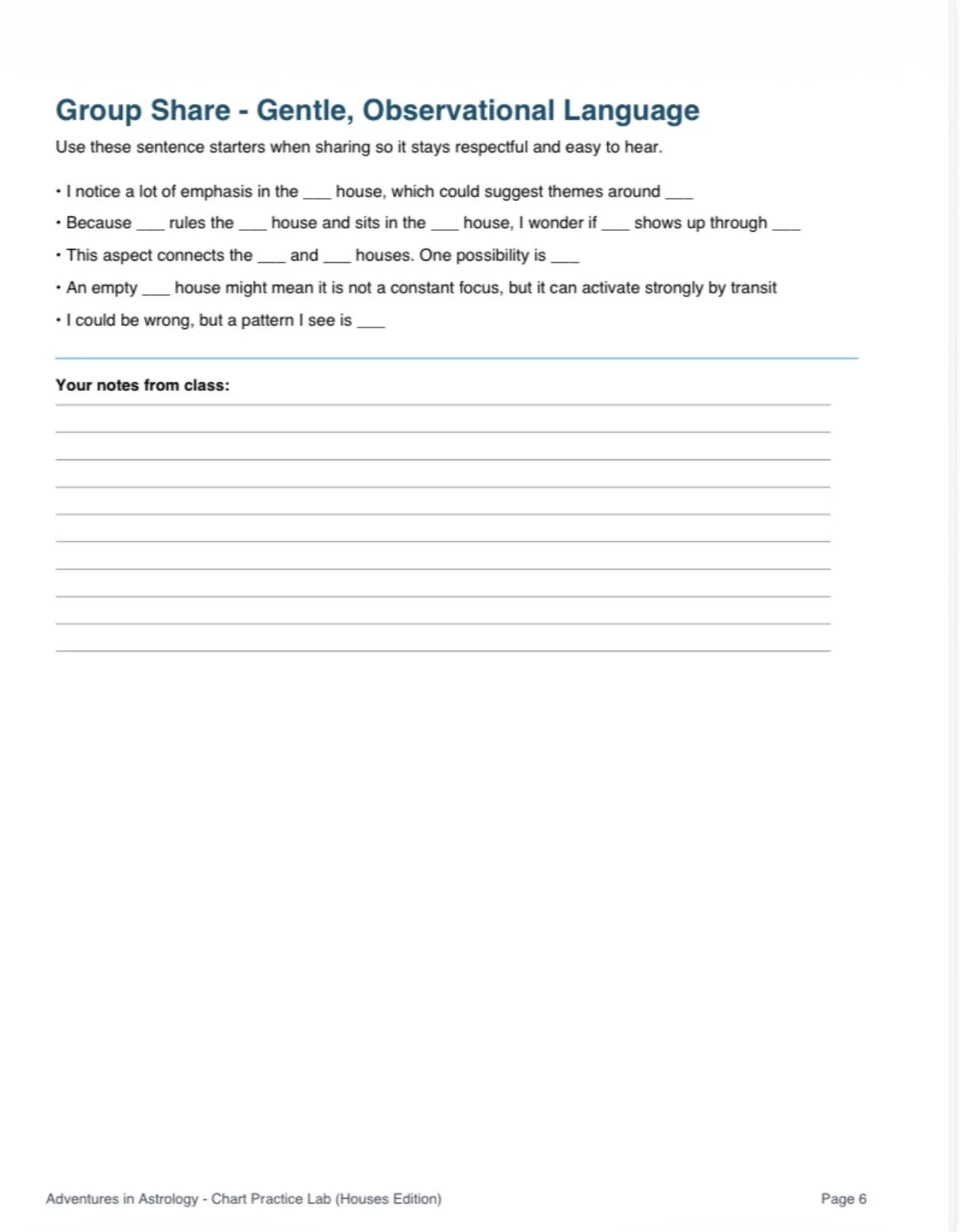
- Notebook or notes app for quick observations
- Optional: colored pens or highlighters for marking key placements and transits
Agenda (suggested timing)
| Time | Segment | What we do |
|---|---|---|
| 10 min | Welcome and warm up | Set intention, quick recap, and a one word chart weather check in |
| 15 min | Your chart foundation | Big 3, chart ruler, emphasis, and 2 to 3 core storylines |
| 20 min | House system lab | Compare Whole Sign, Placidus, and Equal using 2 to 3 planets that shift houses |
| 20 min | Transit mini lesson | Find the loudest transit, then interpret one transit together step by step |
| 20 min | Overlay lesson | Students overlay their chart with the host chart and share one clear observation |
| 10 min | Close out | Takeaways, quick Q and A, optional homework |
House system lab
| Planet | Sign / Degree | Whole Sign house | Placidus house | Equal house | Quick notes |
|---|---|---|---|---|---|
| 1 | |||||
| 2 | |||||
| 3 |
Transit method + notes
- Identify the loudest transit. Look for conjunctions, oppositions, and squares first
- Check what natal point is being hit. Sun, Moon, Ascendant, chart ruler, or an angle
- Name the house being activated in the natal chart. That house tells you the life area
- Translate it into two sentences. One psychological theme. One practical life theme
- Choose a best use. What action, boundary, or focus helps you work with it cleanly
Overlay lesson: put your chart with the host chart
- Personal planet contacts: Sun, Moon, Mercury, Venus, Mars to the host Sun, Moon, Ascendant
- House overlays: where your Sun and Moon land in the host houses
- One repeating pattern: notice what shows up across multiple people
Quick click instructions
- Switch house systems: open chart settings, change house system, compare where planets land by house
- Add transits: turn on transits to natal, set date to today, start with conjunctions, oppositions, squares
- Overlay charts: use Synastry or Bi wheel, host as Person A, student as Person B, keep the same house system for everyone
Optional homework
- Compare your chart in two house systems and write 5 differences you notice
- List your top 3 current transits and what houses they activate
- Pick one transit and write a two sentence interpretation using the method above
Natal Chart Patterns and Shapes Interpreter
Tap a pattern or shape to generate a focused interpretation you can paste into notes, client writeups, or class handouts.