

Venus & the Anatomy of Worth
What do you chase. What do you avoid. What keeps repeating in love, money, creativity, and your sense of self-worth.
Where Venus Sits in Hidden Patterns
Hidden Patterns pairs astrology with depth psychology. The aim is to understand not only what is happening in the chart, but why certain themes keep returning across a life.
We have worked with the Descendant (what we meet through others), Saturn (what we avoid), and Pluto (what we bury). Venus is quieter than all of them, and for that reason harder to catch.
Venus feels like taste. It feels like "just what I like." That is exactly why it runs the show without being noticed.
What We Will Explore
For beginners and experienced students alike. Bring your chart if you have one. No prior knowledge is required.
The Psychology of Venus Beyond Romance
Popular astrology reduces Venus to love and romance. That is one room in a much larger house.
Venus is the function that decides what we treasure and how we relate to it. It governs desire and pleasure, taste and aesthetics, the capacity to receive, and the felt sense of our own worth. Romance is simply the most visible place it shows up.
Underneath the surface, Venus is running a template: what we are drawn toward, what we will tolerate, and what we quietly believe we deserve.
What Venus Actually Governs
Values
What you treasure and refuse to compromise. The quiet hierarchy behind your choices.
Attraction
What magnetizes you, and what you magnetize in return.
Pleasure
What soothes and delights you, and whether you let yourself have it.
Receiving
The capacity to take in love, help, and abundance without deflecting.
Relating
Your relational style in every bond, not only the romantic one.
Worth
The baseline sense of deserving that shapes love and money alike.
Venus as a Hidden Pattern
A pattern stays hidden when it disguises itself as personality. Saturn announces itself as fear. Pluto announces itself as intensity. Venus does not announce anything. It simply feels like preference.
So we rarely question it. We call it "my type," "my taste," "the kind of thing I go for." We treat the pattern as if it were free choice.
Attachment Styles & Natal Venus
Attachment theory describes how early bonds train us to expect closeness or to brace against it. Those expectations become the operating system we bring into adult love.
Venus is where that operating system shows up in the chart. Not as a verdict, but as a tendency. The condition of Venus, its sign, house, and hard aspects, often mirrors the attachment strategy a person learned to survive.
These are correlations, not sentences. The chart describes the pattern. It does not trap you in it.
The Four Styles
Secure
Comfortable with closeness and with space. Can need and be needed without alarm.
Anxious
Fear of abandonment. Seeks reassurance, reads for threat, gives too much to hold the bond.
Avoidant
Prizes independence. Deactivates need, keeps a hand on the exit, mistakes distance for strength.
Disorganized
Wants closeness and fears it at once. The push and pull, drawn in then compelled to flee.
Notice which one you recognize before we look at where it lives in the chart.
Reading Attachment in the Chart
Start Here
Venus by sign and house: how you relate and what you value.
The Moon and the 4th house: the earliest experience of being soothed and safe.
Moon to Venus aspects: how safety and love were braided together.
Then the Teachers
Venus to Saturn often leans avoidant or worth-fearing.
Venus to Uranus needs room and can fear being trapped.
Venus to Neptune or Pluto can run anxious, merging, or intense.
Read the whole picture. One aspect is a thread, not the sweater.
Love Versus Projection
Projection is what happens when a trait we have not claimed in ourselves shows up wearing someone else's face. We first met it at the Descendant. Venus adds its own flavor.
Venus projection is the golden version. We do not project a flaw. We project an ideal: the beauty, the potential, the wholeness we long for and have not yet found inside.
We fall in love with who we imagine, then feel betrayed when the real person cannot hold the projection.
Three Ways It Shows Up
Idealization
Seeing the best possible version and missing the actual person in front of you.
The Type
The recurring template. The same person in different bodies, chosen before you consciously choose.
Falling for Potential
Loving who someone could become, and staying for the promise rather than the reality.
The cure is not cynicism. It is recognizing the projection so real intimacy can begin.
Self-Worth, Money, Pleasure, Values
Venus rules Taurus and the 2nd house, the ground of resources and self-worth. This is the least romantic and most important part of Venus.
Worth is the root. Love and money both grow from the felt sense of deserving. When that sense is thin, the same pattern appears in both arenas: over-giving, under-charging, tolerating scarcity, chasing validation to fill the gap.
Change the root and both branches change with it.
Worth, Money, and Values
The Pattern
What you charge, what you accept, and what you settle for all track the same inner number: how much you believe you are worth.
Money and love are the same lesson in different currencies.
Values
Values are Venus deciding what deserves your time, money, and devotion.
When we live against our real values, Venus registers it as a low hum of dissatisfaction that no new purchase or partner resolves.
Pleasure and the Capacity to Receive
Many people can give freely and cannot receive at all. Compliments get deflected. Help gets refused. Rest feels unearned. That is a Venus wound, not a virtue.
The shadow runs two directions. On one side, deprivation: denying yourself pleasure until you have earned it, which is never. On the other, overconsumption: reaching for pleasure to numb rather than to nourish.
Shadow Venus by Sign: Fire & Earth
Shadow Venus by Sign: Air & Water
Shadow Venus by House: the Arena
The sign colors the style. The house shows the arena where the worth-and-desire pattern actually plays out.
Venus Retrograde & Internalized Patterns
Roughly every eighteen months Venus turns retrograde for about forty days. Over eight years these turning points trace a five-petaled rose across the zodiac, returning near the same degrees. The shape on the title slide is that real orbital pattern.
Astrologically, a Venus retrograde is a review, not a launch. Values, relationships, worth, and money come back up for re-evaluation. Old connections resurface. Tradition counsels against new commitments and major purchases during the passage.
Venus Retrograde in the Natal Chart
Born under a Venus retrograde, love and worth are learned inwardly first. There is often an early sense of being out of step with conventional relating, a private or unconventional relationship to affection.
The pattern is internalized and self-referential. Rather than taking cues from the culture about what to want, this Venus keeps re-examining what love and value actually mean, from the inside.
Venus Aspects: the Hard Teachers
The outer planets and Chiron do not soften Venus. They apply pressure to it, and the pressure is where the hidden pattern usually lives.
The five that follow are the classic teachers. Hard aspects, the conjunction, square, and opposition, carry the most charge, but any contact colors the way Venus loves and values.
Look for these in your own chart as we go. If you have your placements, note which teachers you carry.
Venus and Saturn
The pattern. Love filtered through a fear of rejection and a quiet belief in unworthiness. Love as something to earn, to work for, to prove. The "not enough" voice runs in the background.
The shadow. Withholding, guardedness, choosing distance to avoid the risk of wanting. Delayed or overly serious love. Loyalty that can curdle into obligation.
The gift. Once the fear is faced, a love that is durable, committed, and real. Saturn keeps what it builds.
Venus and Pluto
The pattern. Love as intensity and transformation. The drive to merge completely, and a deep fear of loss or betrayal underneath it.
The shadow. Jealousy, control, testing, and power struggle. All-or-nothing bonds that consume. An old powerlessness in love seeking to never be at anyone's mercy again.
The gift. When the compulsion is made conscious, a capacity for profound, transformative intimacy that most people never reach.
Venus and Neptune
The pattern. Romantic longing and idealization. The soulmate fantasy, love as transcendence, the wish to dissolve into another.
The shadow. Boundary loss, rescuing, sacrificing, and self-deception. Falling for the ideal and grieving when the real person cannot hold it. Vulnerability to being misled, or to misleading yourself.
The gift. Once grounded, a genuine capacity for compassion, devotion, and unconditional love.
Venus and Uranus
The pattern. A strong need for freedom and space. Attraction to the unusual, the exciting, and sometimes the unavailable. Excitement valued over stability.
The shadow. On-again off-again cycles. Sudden attractions and sudden exits. Fear of being trapped, so intimacy is kept at a safe, electric distance.
The gift. Authenticity over convention, and the ability to love without needing to possess.
Venus and Chiron
The pattern. The love wound. A core sense of being unlovable, unworthy, too much, or not enough. Heightened sensitivity to rejection.
The shadow. Repeating the wound. Attracting people who confirm the old belief, or leaving before the wound can be touched. Flinching at the very closeness that could heal it.
The gift. Once tended, this Venus becomes able to hold other people's worth wounds with rare gentleness. The wounded healer in love.
How Childhood Shapes Venus
Venus is trained early. Long before romance, a child learns how love is given: freely or conditionally, warmly or coldly, reliably or unpredictably. That first experience sets the template for what will later feel like love.
The child learns what earns affection, what love seems to cost, and whether they are worthy of it at all. Those lessons harden into adult "preferences" that are really old adaptations still running.
Recognizing Repeating Cycles
The same partner in different bodies. The recurring ending. The role you keep playing: the rescuer, the pursuer, the one who withholds, the one who leaves first.
A repeating cycle is Venus trying to complete an old story. The unconscious keeps casting the same play, hoping this time it ends differently.
Recognition is the break in the loop. You cannot change a pattern you cannot see, and you cannot help but change one you truly can.
Reflection Exercises
- Name the three people you were most drawn to. Beneath the surface, what did they share?
- When do you feel most worthy of love, and least? What condition sits underneath the feeling?
- Where do you over-give and under-receive? What would receiving fully actually feel like?
- What is the ending you keep arriving at, and whose story does it complete?
Use the on-page Hidden Patterns journal, or your own notebook. Write before you interpret.
Hidden Patterns
Astrology met with depth psychology. Not only what is happening in your chart, but why the same themes keep returning.
Recognize the pattern. Understand the why. Reclaim the power.
Each class stands on its own. Join any week. Bring your chart, or simply listen and observe.
Pluto and the Anatomy of Power
What we bury so deeply it begins to run us, and what it costs to bring it back into consciousness.
Where This Class Fits
Saturn is what we hesitate to approach. Pluto is what we buried so deeply that it started acting from underneath.
This is the central distinction for today’s class.
What We Are Covering
Pluto Basics
What Pluto represents psychologically, symbolically, and astrologically.
The Shadow Pattern
Control, buried material, projected power, obsession, fear, and intensity.
Chart Reading
How to read Pluto by house, sign, aspects, and transits.
Integration
How to name the pattern without shaming it or letting it run the room.
Pluto Is Not Subtle
Pluto describes the places where life does not stay light, casual, or surface-level.
Where Pluto is active, something tends to feel charged, loaded, private, intense, compulsive, or difficult to explain rationally.
Pluto asks: Where did power become unsafe, and what did you do to survive that?
The Vocabulary of Pluto
Power
Authority, force, survival, influence, control, and the ability to affect outcomes.
Depth
The hidden layer beneath the visible behavior, story, or conflict.
Compulsion
The repeated pattern that feels bigger than conscious choice.
Death
The ending of an identity, attachment, role, fantasy, or control strategy.
Rebirth
The stronger, truer version that emerges after the false structure collapses.
Shadow
The disowned force that still shapes behavior from outside awareness.
Pluto Is Not the Wound Itself
Pluto is the survival intelligence that formed around the wound.
It is the grip, the defense, the obsession, the emotional charge, the power strategy, and the pattern that says, “Never again.”
This is why Pluto can look destructive and protective at the same time.
The Pluto Shadow Pattern
Control
The grip that forms when safety feels uncertain.
The Buried
The rage, grief, fear, hunger, desire, or truth that was pushed underground.
Projected Power
The power we hand to others because we have not fully claimed it ourselves.
Control
Control is often a trauma response dressed as strength.
It may show up as monitoring, testing, withholding, strategizing, obsessing, bracing, or trying to predict every possible threat.
The deeper question: Where did uncertainty once feel dangerous?
The Buried
The buried part does not disappear. It becomes pressure.
It may leak out as intensity, resentment, obsession, shutdown, jealousy, fear, secrecy, or a strong emotional reaction that feels larger than the present moment.
The deeper question: What was too much to feel when it first happened?
Projected Power
Projected power happens when we locate our own force in someone else.
We may fear them, envy them, resent them, obsess over them, or believe they hold the key to our freedom.
The deeper question: What part of your own power are they carrying for you?
How to Read Pluto
Pluto by House
The house is the arena.
This is where Pluto becomes specific to the person’s lived experience. It shows where power, fear, control, secrecy, intensity, and transformation are most likely to concentrate.
For teaching purposes, start with the house before over-focusing on the sign.
Pluto Through the Houses
1st House
Power through identity, presence, survival, body, and how others experience your intensity.
2nd House
Power through money, worth, possessions, scarcity, stability, and self-value.
3rd House
Power through voice, siblings, learning, perception, words, and mental control.
4th House
Power through family, ancestry, home, childhood, privacy, and the buried past.
Pluto Through the Houses
5th House
Power through creativity, romance, children, visibility, pleasure, and being seen.
6th House
Power through work, health, service, routine, crisis management, and body patterns.
7th House
Power through partnership, projection, attraction, conflict, and relational intensity.
8th House
Power through intimacy, shared resources, death, inheritance, secrets, and psychic merging.
Pluto Through the Houses
9th House
Power through belief, truth, religion, worldview, education, travel, and moral certainty.
10th House
Power through career, authority, reputation, visibility, legacy, and public control.
11th House
Power through groups, networks, friends, movements, exclusion, and collective influence.
12th House
Power through the unconscious, isolation, hidden enemies, dreams, grief, and ancestral residue.
Pluto by Sign
Pluto’s sign describes a collective survival imprint.
Because Pluto stays in one sign for many years, people born in the same era share a similar generational wound, obsession, and transformation assignment.
The sign gives atmosphere. The house and aspects give the personal story.
Pluto Sign Themes
Aspects Carry the Heat
Pluto aspects show where the emotional charge concentrates.
A Pluto aspect does not automatically mean catastrophe. It means the contacted planet is not casual. It is deepened, intensified, pressurized, and transformed.
The tighter the aspect, the more noticeable the pattern usually becomes.
Pluto With Personal Planets
Pluto Sun
Power through identity, will, visibility, father themes, and the right to exist fully.
Pluto Moon
Power through emotion, safety, attachment, mother themes, memory, and emotional survival.
Pluto Mercury
Power through thought, language, secrecy, persuasion, obsession, research, and mental control.
Pluto Venus
Power through love, beauty, desire, money, attraction, jealousy, abandonment, and merging.
Pluto With Mars and Angles
Pluto Mars
Power through force, anger, sexuality, survival drive, competition, and the fear of being overpowered.
Pluto Ascendant
Power through presence, body, first impressions, self-protection, and how others project intensity onto you.
Pluto Descendant
Power through partners, conflict, obsession, attraction, projection, and relational shadow work.
Pluto Midheaven
Power through career, public role, authority, reputation, ambition, and legacy transformation.
How the Aspect Behaves
Pluto Transits
Pluto transits are slow. They usually describe a long process, not a single event.
When Pluto touches a natal planet or angle, that part of life enters a deep restructuring period.
The first pass often exposes the issue. The retrograde pass intensifies and reviews it. The final pass asks for integration.
Pluto Square Pluto
Pluto square Pluto is often a midlife crucible.
It brings pressure to the survival strategies built earlier in life. What once protected the person may now feel too small, too controlling, or too costly.
This transit asks: What has power over you because you have not fully faced it?
Common Themes
Old Survival Patterns Fail
The old defense system starts creating the very pain it was designed to prevent.
Power Gets Renegotiated
The person confronts where they have been controlled, controlling, or afraid to choose.
Buried Truth Surfaces
Unprocessed material rises through dreams, conflict, crisis, obsession, or intense emotional recognition.
A New Identity Forms
The person begins shedding the role that was built around fear.
The Four-Step Pluto Method
Pluto Reflection Questions
Pluto Work Is Not Self-Blame
The purpose is not to label Pluto as bad, dark, broken, or shameful.
The purpose is to see the pattern clearly enough that it stops operating unconsciously.
Awareness does not erase the past. It changes who is driving now.
What Belongs to You Now?
Pluto does not ask us to become soft in a fake way.
It asks us to stop confusing survival armor with actual power.
Real power is not the grip. Real power is the capacity to stay present with truth.
Recognize the pattern. Understand the why. Reclaim the power.
Hidden Patterns III · Pluto and the Anatomy of Power · Adventures in Astrology
Advanced Chart Calculator
Enter a birth city — we'll handle coordinates, timezone, and historical DST automatically. Calculations run entirely in your browser with arcminute accuracy.
Fill in the fields above and click Calculate Chart.
Shadow Work Through Astrology
An exploratory companion. Calculate your chart, feel the sky now, surface shadow patterns, and journal what emerges.
—
The Descendant & Projection
The 7th house and Descendant reflect traits we meet through others — how projection shows up through attraction, irritation, and repeated relationship patterns.
Nothing is labeled good or bad. The focus is on recognizing patterns and understanding how they function.
Saved locally in your browser. Private to this device.
Hidden Patterns
The chart reveals what the conscious mind avoids.
About the Series
An ongoing astrology series focused on understanding the shadow self through the birth chart.
Rather than focusing only on personality traits, we explore the patterns that operate beneath the surface — the ones that show up in reactions, relationship dynamics, and repeated life themes.
Topics We Rotate Through
Together, these reveal how the chart reflects both conscious and unconscious behavior.
A Grounded Approach
- ✦ Nothing is labeled as good or bad
- ✦ The focus is on recognizing patterns and understanding how they function
- ✦ Clear structure, real examples, practical application
- ✦ Bring your chart — or simply listen and observe
The Descendant & Projection
This session explores how the 7th house and Descendant reflect traits we meet through others — including how projection shows up through attraction, irritation, and repeated relationship patterns.
Friday, April 17, 2026
Hidden Patterns · Week 1
The Descendant & Projection
The 7th house and Descendant reflect traits we meet through others — attraction, irritation, and repeated relationship patterns.
Slide 01 · Overview
☍What the Descendant Reveals
The Descendant sits opposite the Ascendant — the cusp of the 7th house. If the Ascendant shows how you arrive in the world, the Descendant shows what you meet in the world: partners, adversaries, mirrors.
It is rarely a random cast of characters. The people we're drawn to, irritated by, or repeatedly entangled with tend to carry qualities we haven't fully claimed in ourselves.
Slide 02 · Class Activities
✦What We'll Do This Session
- Locate your Descendant sign and 7th house ruler in your chart
- Identify any planets sitting in the 7th house and what they describe
- Map the Ascendant–Descendant axis as a polarity, not a split
- Trace projection patterns: attraction, irritation, repetition
- Look at composite and synastry overlays for recurring partners
- Journal one pattern you're ready to reclaim
Bring your chart — or simply listen and observe. Nothing is labeled good or bad. The focus is recognizing patterns and understanding how they function.
Slide 03 · Core Concept
⚷Projection, Defined
Projection is what happens when a trait we haven't integrated shows up wearing someone else's face. It's usually felt as strong attraction, strong irritation, or a story that keeps repeating with different cast members.
The Descendant is the doorway. The 7th house is the room. The planets and aspects there describe the flavor of what gets outsourced — and the people who tend to carry it back to us.
Slide 04 · The Axis
⇄Ascendant ⇄ Descendant
The Rising sign and the Descendant are always opposite signs on the same axis. Self and Other. How I show up, and who I meet. These two points work together — a polarity the chart is asking you to hold, not resolve.
Slide 05 · The 7th House
7The House of the Other
Partnerships, marriages, business collaborators, declared enemies, open agreements. The 7th house shows where we meet ourselves through another — and where contracts, both literal and psychological, are signed.
Slide 06 · Relationship Patterns
♥Who We Attract & Repeat
Once you see your Descendant clearly, relationship patterns stop looking like bad luck and start looking like a signature. Compatibility work gives you the tools to read that signature in a second chart — or across a shared one.
Slide 07 · Oppositions & Aspects
☍The Geometry of Projection
The Ascendant–Descendant axis is the chart's most personal opposition. Any planet opposing your Ascendant is, by definition, living near your Descendant. That's a lot of information about who keeps showing up in your life.
Slide 08 · Your Descendant Sign
♈Read It by Sign
The sign on your Descendant colors the qualities you tend to project — the ones you outsource to partners first, then later recognize as your own. Use these references to read your specific Descendant sign and the planets that live there.
Slide 09 · Get Your Chart Ready
⌖Calculate, Print, Work
You'll get the most from this session with your chart in front of you. Use these tools to calculate it, and grab the worksheets to mark up your Descendant, 7th house, and relevant oppositions before class.
Slide 10 · Shadow Work
☽From Pattern to Insight
Recognition is the first half. Reclamation is the second. Use the on-page Hidden Patterns journal tool above — or these hubs — to track which Descendant themes you're ready to pull back into yourself.
Slide 11 · Reference
✺Glossaries & Links
Any term that came up mid-class and you want to look up later — start here. Everything cross-referenced across the Adventures In Astrology library.
Slide 12 · Join Us
✦Attend & Keep Learning
Each class stands on its own. Join any week. Returning participants build deeper understanding session by session. Here's how to plug in.
Descendant & 7th House Interpreter
The Descendant is your relationship mirror — the sign, planets, and aspects on your 7th house cusp reveal what you project onto others, who you attract, and the qualities you learn to reclaim in yourself. Build a combination below for an in-depth, layered interpretation.
Your personalized Descendant interpretation will appear here.
Sign Interpretations · Planets Through the Signs · Astrology Interpretation Hub · House Systems · References & Links
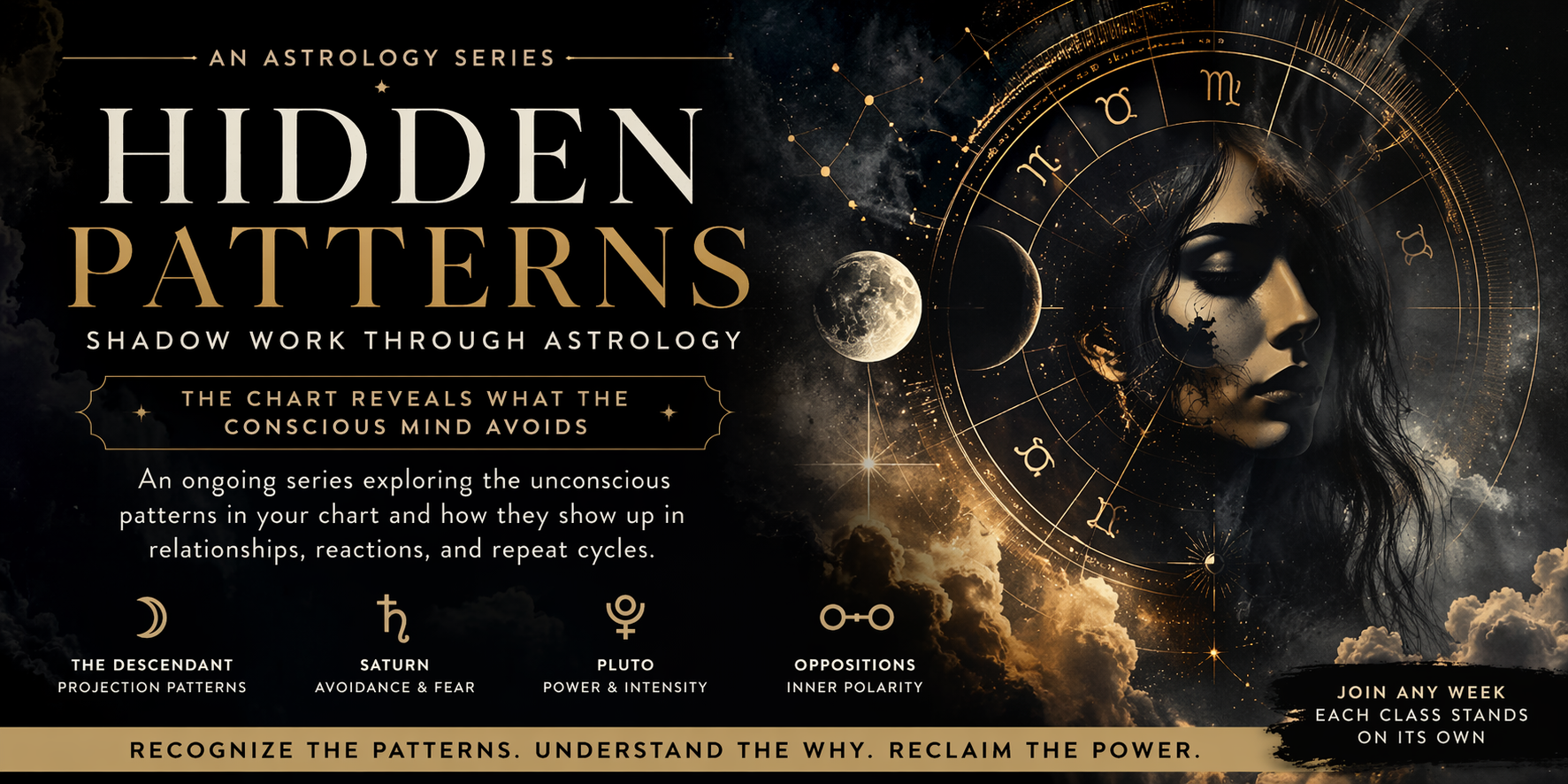
Saturn & the Architecture of Fear
Where the chart says not yet, not enough, not safe — and what gets built in its place.
Where We've Been
Last session we worked with the Descendant — the part of the chart that shows what we meet through other people, and the projection patterns that keep certain qualities outside ourselves until we're ready to claim them.
This week, we go from what gets projected to what gets avoided.
What Saturn Actually Does
Saturn defines edges. Where it sits is where reality has been firm with you — sometimes early, sometimes harshly.
Saturn is the planet of slow mastery. Anything Saturn touches matures late, and rewards patience over speed.
Saturn carries the imprint of who said yes and no to you first — and the inner voice that now says it for them.
Saturn turns intention into structure. It is what survives, what gets built, and what holds weight.
Three Faces of Saturn Shadow
The topic, role, or risk that you simply do not approach. The thing you're "not the kind of person" to do — even when, quietly, you are.
The specific dread that lives under it. Often older than you. Often inherited. Almost never about what it appears to be about.
The exaggerated mastery you build right next to the wound — so impressive that no one, including you, notices what it covers.
Reading Saturn in Your Chart
Two coordinates carry most of the meaning:
Tells you the flavor of the avoidance — what it feels like, what voice it speaks in. Saturn in fire fears spark; in earth fears scarcity; in air fears being unintelligible; in water fears being too much.
Tells you the arena — the actual area of life where the pattern plays out. Saturn in the 5th does not fear "being judged" in the abstract; it fears being seen creating, loving, or playing.
The Cycle That Re-Asks the Question
Saturn returns to its natal place roughly every 29.5 years. At those moments — and at the squares and oppositions in between — life tends to ask the same question more honestly than before.
From Defense to Authorship
Saturn's shadow softens not by force but by witnessing. The pattern was built by a younger version of you, for a real reason. The work is to thank it, name what it's protecting, and decide — as the adult — what now belongs.
Where in your life have you become impressively competent at avoiding the thing you actually want?
Whose voice is your inner critic borrowing from?
What would it look like to be the gentle authority you wish you'd had?
Hidden Patterns
Recognize the pattern. Understand the why. Reclaim the power.
Descendant and 7th House Interpreter
The Descendant is your relationship mirror. The sign, planets, and aspects connected to your 7th house reveal what you project onto others, who you attract, and the qualities you learn to reclaim in yourself.
Your personalized Descendant interpretation will appear here.
Pluto & the Anatomy of Power
Find your Pluto, name what it’s protecting, and trace the slow pressure that asks it to come up into the light.
Pluto isn’t doom. It’s the part of the chart asking: what have you buried so deep it’s started running you — and are you ready to bring it up and own it?
Enter birth details and calculate to surface your Pluto — its sign, house, and the three faces of its shadow.
Pluto takes ~248 years to circle the chart, so a Pluto return is out of reach. The defining personal marker is the day transiting Pluto squares its own natal place — the midlife crucible. Plus any slow transit Pluto is making to your chart right now.
Calculate your chart first (in Your Pluto), then run this to find your Pluto-square-Pluto window and current Pluto transits.
Every planet that aspects your Pluto tells a story about how power moves through that part of you. The aspects carry the heat.
Calculate your chart first (in Your Pluto), then run this to read every aspect to your natal Pluto.
Saved locally in your browser. Private to this device.
Pluto & the Anatomy of Power
What we bury so deep it begins to run us from below — and how it asks to be reclaimed.
Where We’ve Been
We began with the Descendant — what we meet through other people, and the projection patterns that keep certain qualities outside us until we’re ready to claim them.
Then Saturn — what we avoid, the fear underneath it, and the impressive competence we build right next to the wound.
This week we go deeper than avoidance. ♯ Pluto is what we don’t merely avoid — it’s what we have buried, and what now exerts pressure from below.
What Pluto Actually Does
Depth
Pluto pulls things down to the root. Where it sits, the surface answer is never the real one — there is always a buried layer underneath.
Power
Pluto marks where we feel powerless, and so where we grasp for control. The drive to never be at anyone’s mercy lives here.
Death & Rebirth
Pluto ends things so something truer can take their place. It does not renovate — it demolishes and rebuilds.
Compulsion
What we refuse to face becomes a force that repeats. Pluto is the pattern that runs through us until it’s made conscious.
Three Faces of Pluto Shadow
Control
The grip. Managing, monitoring, and bracing so that nothing can blindside you again. It looks like strength; it’s built on an old powerlessness.
The Buried
The thing pressed so far down you’ve forgotten it’s there — rage, desire, grief, hunger. It doesn’t disappear. It leaks, or it erupts.
Projected Power
Power we won’t own gets handed to others — then resented, feared, or obsessively circled. We meet our own intensity wearing someone else’s face.
Reading Pluto in Your Chart
By House
The arena — the actual area of life where the power struggle plays out. Pluto in the 8th works through intimacy and shared resources; in the 10th, through authority and reputation; in the 4th, through family and the buried past.
House carries most of the personal meaning. This is where your Pluto lives, not your whole generation’s.
By Sign
The generation. Pluto spends 12–20 years in a sign, so it describes the collective wound and obsession of an era more than a single person.
Read sign for the cultural water you swim in; read house and aspects for the personal charge.
Aspects carry the heat. Pluto–Sun: power and identity, the father-line of control. Pluto–Moon: buried emotion, intensity around safety and the mother. Pluto–Venus: love as merging, jealousy, the fear of being consumed or abandoned. Pluto–Mars: raw will, survival drive, the question of force.
The Pressure That Builds Slowly
Pluto takes about 248 years to circle the chart, so almost no one lives to a Pluto return. Its pressure is generational and slow — but it does turn the screw on you personally, at a few defining points.
Because Pluto’s orbit is so eccentric, the timing of its square to itself varies widely by generation — the tool calculates yours from the live ephemeris.
From Compulsion to Sovereignty
Pluto’s shadow doesn’t soften through force — force is its native language and only feeds it. It softens when the buried thing is brought up into the light, named, and finally given a seat at the table as an adult.
- Where in your life are you holding a grip so tight you’ve mistaken it for strength?
- What have you buried — a hunger, a rage, a grief — because it felt too much to be allowed?
- Whose power are you circling, envying, or fearing — and what part of your own does it mirror back?
Hidden Patterns
Recognize the pattern. Understand the why. Reclaim the power.
Each class stands on its own. Join any week.